
Integrating AI tools & automation has evolved from running isolated chatbot prompts to engineering end-to-end autonomous business logic. In a competitive operational landscape, relying on manual data entry, fragmented communication chains, and disconnected software systems drains organizational velocity. Transitioning to modern intelligent pipelines allows businesses to parse unstructured datasets, execute complex multi-step reasoning, and trigger deterministic real-world actions without constant human intervention.
Sustainable productivity gains do not come from superficial novelty apps. Instead, high-impact implementation demands a structured tech stack combining robust language models, vector databases for retrieval-augmented generation (RAG), and reliable workflow orchestrators. By treating artificial intelligence as an active execution engine rather than a mere writing assistant, modern professionals can eliminate operational friction and compound their output across entire business operations.
Key Takeaways
- Agentic Workflows Outperform Static Prompts: Shifting from single-turn LLM queries to autonomous loops—where agents reason, select specific tools, validate outputs, and self-correct—enables the automation of intricate, non-linear business objectives.
- Orchestration Platforms Provide the Glue: Visual engines like n8n and Make, alongside code-first frameworks like LangGraph and CrewAI, bridge machine intelligence with operational databases, CRMs, and APIs.
- Retrieval-Augmented Generation (RAG) Grounds Decision-Making: Anchoring models to private vector stores prevents hallucinations, maintains data privacy, and supplies domain-specific context in real time.
- Human-in-the-Loop (HITL) Guardrails Protect Quality: Injecting deterministic verification checkpoints before executing financial transactions, customer communications, or database writes ensures strict regulatory and operational compliance.
Technical Comparison: Workflow Automation Tiers
Selecting the right framework requires balancing technical complexity, data privacy, and architectural flexibility.
| Tier / Platform Category | Technical Barrier | Primary Operational Architecture | Data Sovereignty & Hosting | Ideal Business Use Case |
| No-Code SaaS Integrators (e.g., Zapier) | Very Low (Non-technical users) | Linear if-this-then-that triggers with embedded LLM steps | Cloud-only (Vendor multi-tenant infrastructure) | Straightforward app-to-app syncing, basic lead alerts, simple inbox sorting |
| Visual Hybrid Orchestrators (e.g., n8n, Make) | Moderate (Low-code / JSON logic) | Visual node pipelines with branching, iterators, and native AI agent nodes | Self-hostable (Docker/VPS) or managed secure cloud | Complex business logic, nested JSON data parsing, multi-app agentic workflows |
| Code-First Multi-Agent Frameworks (e.g., LangGraph, CrewAI) | High (Python / TypeScript engineers) | Stateful directed acyclic graphs ($DAGs$) with specialized supervisor/worker agents | Total control (On-premise bare-metal, private cloud VPC) | Custom autonomous RAG pipelines, proprietary enterprise software integrations |
| AI-Native Coding Environments (e.g., Cursor, Windsurf) | Moderate to High (Developers) | Context-aware inline coding agents and repository-wide indexing | Local engine with cloud LLM endpoint routing | Rapid engineering of custom automation scripts, API glue code, and microservices |
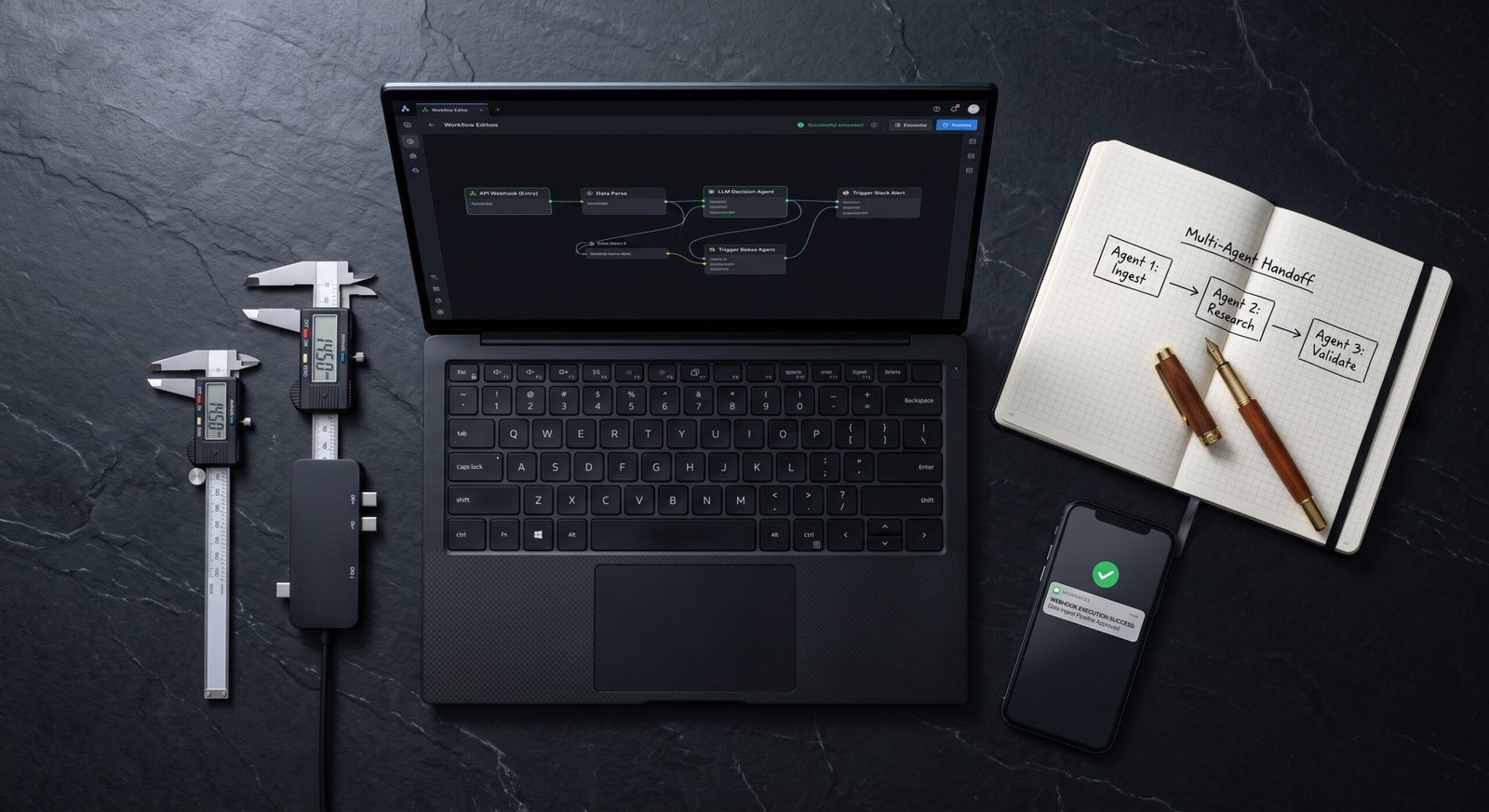
3 Core Pillars of High-Performing AI Tools & Automation
Constructing a reliable digital pipeline requires treating workflows as disciplined software engineering projects rather than chaotic prompt experiments.
1. Agentic Logic and Autonomous Execution Loops
Basic automation simply moves static data between apps; agentic systems dynamically assess incoming inputs to determine the proper path forward.
- Tool Calling and Function Execution: Modern large language models excel at evaluating unstructured requests—such as messy inbound client inquiries—and transforming them into structured JSON schema to execute external API calls directly.
- Supervisor-Worker Patterns: Instead of forcing a single massive prompt to handle an entire enterprise task, deploy specialized micro-agents. A researcher agent gathers raw text, a validation agent verifies factual accuracy against internal knowledge bases, and a publishing agent formats and commits the data.
2. Retrieval-Augmented Generation (RAG) with Vector Databases
Raw base models lack awareness of proprietary company documentation, client records, and real-time inventory.
- Chunking and Semantic Search: Ingest private PDF documentation, transaction histories, or technical guides into vector embeddings. Tools like Pinecone, Weaviate, or local Chroma instances map semantic meaning so the model can retrieve exact passages when generating responses.
- Eliminating Model Drift and Hallucination: Constraining generation exclusively to retrieved context prevents costly mistakes, ensuring the system delivers reliable, grounded answers every time.

Production Reliability: Preventing Automated Failure Cascades
Without disciplined controls, automating tasks at scale only accelerates errors. Hardening your systems against unexpected edge cases is critical:
- Idempotency and Error Handling: Design every webhook and API call to be idempotent. If a network blip occurs mid-execution, automatic retries must not result in duplicate customer charges or repeated database entries.
- Cost and Token Rate Limiting: Establish strict token-spending limits and latency circuit breakers. A rogue multi-agent loop that continually queries a reasoning-heavy frontier model can burn through thousands of dollars in API credits within hours.
- Human-in-the-Loop Escalation: For irreversible actions—such as processing contract payouts, deploying production code, or dispatching external client emails—require an asynchronous Slack, Teams, or email approval step before the pipeline completes.

Engineering Long-Term Operational Leverage
Adopting modern artificial intelligence is no longer about testing basic conversational prompts; it is about systematically untethering human time from repetitive digital tasks. By coupling visual and code-first orchestrators, implementing vector-grounded context, and maintaining strict operational guardrails, you build a self-sustaining infrastructure that compounds value around the clock. Treating AI tools & automation as core organizational capital ensures that your systems scale cleanly, reduce cognitive overhead, and maintain peak competitive performance.
Frequently Asked Questions About AI Tools & Automation
What is the difference between traditional robotic process automation (RPA) and AI-driven automation?
Traditional Robotic Process Automation is strictly rule-based and brittle. It mimics deterministic user actions—such as clicking on exact desktop coordinates or copying data from static spreadsheet cells—and completely breaks if a user interface or field format changes slightly. AI-driven automation incorporates machine learning to understand unstructured inputs (such as parsing freeform emails, interpreting PDFs, or writing adaptive code) and dynamically solves problems even when data structures deviate from standard templates.
When should a team use n8n or Make instead of Zapier?
Zapier is ideal for rapid, single-step integrations built by non-technical team members who need immediate out-of-the-box software connectors. However, teams transition to n8n or Make when they require complex branching logic, multi-stage data transformations, nested JSON handling, and cost-effective execution pricing at volume. Furthermore, n8n is the preferred choice for enterprise environments requiring self-hosted, on-premise deployments to comply with strict data privacy laws (such as HIPAA or GDPR).
What does “Agentic AI” actually mean in practical business workflows?
Agentic AI describes software where a large language model acts as an autonomous reasoning engine rather than just a conversational interface. Instead of simply generating a blocks of text, an agentic system is given a broader goal (e.g., “Analyze yesterday’s sales figures and alert the inventory manager of potential stock shortages”). The agent evaluates available tools, queries internal databases, runs calculations, validates its findings, and triggers alerts autonomously, escalating to a human operator only when unexpected edge cases arise.
1 thought on “AI Tools & Automation: Strategy for Scale and Growth”